Neural Acoustics & Lyria: High-Fidelity Harmonic Synthesis
Examine how Google DeepMind solved long-range musical coherence, hierarchical acoustic tokenization with SoundStream, and algorithmic provenance watermarking via SynthID.
The Challenge of Temporal Scale in Musical AI
Raw audio at 48,000 Hertz produces 48,000 discrete samples per second per audio channel. In a three-minute stereo musical composition, an algorithmic model must maintain structure across over 17 million individual numerical values. Language models struggle with audio because long-range harmonic progression requires coherence across minutes, while timbre, pitch, and transient attacks require microsecond resolution.
To overcome this computational divergence, DeepMind pioneered hierarchical tokenization. Rather than predicting raw waveform samples directly, architectures like SoundStream, AudioLM, and Lyria compress waveform audio into multi-tiered semantic and acoustic token lattices.
Lyria: The DeepMind Music Generation Engine
Lyria represents Google DeepMind’s most sophisticated music model. Designed to provide fine-grained authoring control over style, instrumentation, vocals, and tempo, Lyria combines autoregressive token prediction with latent diffusion post-processing.
Lyria operates across two primary structural tiers:
- Semantic Conditioning Layer: Operates at a low temporal frame rate (approx. 25–50 Hz), establishing harmonic progressions, verse-chorus structure, rhythmic cadence, and instrumental orchestration.
- Acoustic Neural Decoding: Reconstructs full-frequency 48 kHz stereo waveforms using residual vector quantization (RVQ) codebooks, preserving crisp transient attacks, vocal vibrato, and room reverberation.
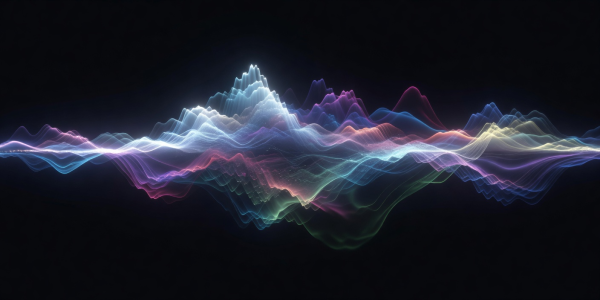
SynthID Audio Watermarking
DeepMind’s imperceptible acoustic watermarking embeds cryptographic provenance directly into audio spectrograms.
SynthID for Audio: Unforgeable Provenance Verification
A critical contribution of DeepMind to generative media governance is SynthID. Traditional audio watermarks rely on high-frequency noise bursts or metadata headers that are easily stripped by MP3 compression, analog recording, or bandpass filtering.
SynthID for audio embeds an imperceptible pattern directly into the spectrogram of the audio waveform before it is converted into acoustic sound. The watermark is trained end-to-end to resist lossy compression, ambient room noise, equalization, and tempo warping without altering musical fidelity or human-perceptible clarity.
Evolution of DeepMind Audio Architectures
| Model Landmark | Primary Innovation | Sample Quality | Coherence Span |
|---|---|---|---|
| WaveNet (2016) | Dilated causal convolutions on raw waveforms | 16 kHz mono | Seconds (Speech focused) |
| SoundStream (2021) | Neural codec with Residual Vector Quantization | 24 kHz mono/stereo | Lossy acoustic compression baseline |
| AudioLM (2022) | Hierarchical semantic + acoustic tokenization | 24 kHz stereo | Tens of seconds (Consistent piano) |
| Lyria (2023–2025) | Native music generation + SynthID watermarking | 48 kHz studio stereo | Full multi-minute track coherence |
Studio Workflow Integration and Limitations
While Lyria unlocks revolutionary capabilities for iterative composition and real-time instrumental stem steering, key challenges remain. Complex polyphonic orchestral layering can still suffer from phase cancellation, and precise word-level lyrical alignment across extended vocal passages requires guided cross-attention intervention.