Genie & World Models: Unsupervised Interactive Latent Physics
Investigating generative interactive environments, unsupervised action latent spaces, and synthetic simulation testbeds trained strictly from unlabeled video.
The Concept of Generative World Models
In traditional reinforcement learning, training an artificial agent requires executing millions of trials inside real physics environments or hand-crafted game engines like Unity or Unreal Engine. Hand-crafting these simulated worlds is painstakingly slow, constrained by explicit programmer assumptions, and unable to scale to the chaotic variety of reality.
World models flip this formulation: what if an AI could learn the rules of mechanics, gravity, inertia, and causality entirely by watching raw video recordings, and then simulate responsive, controllable environments inside its own neural parameters? DeepMind achieved this milestone through Genie (Generative Interactive Environment).
Genie: Training Controllable Worlds Without Action Labels
The defining scientific breakthrough of Genie is learning controllable dynamics from completely unlabeled video. Traditional imitation learning requires paired $(state, action)$ datasets—meaning human players had to record their controller keystrokes alongside gameplay footage.
Genie was trained on over 200,000 hours of publicly available 2D platformer gameplay video with zero controller telemetry. To achieve interactivity, DeepMind devised a tripartite neural architecture:
- Spatiotemporal Video Tokenizer: Compresses continuous video frames into discrete discrete tokens, minimizing frame-to-frame pixel redundancy.
- Latent Action Model (LAM): Unsupervised network that inspects transition differences between frame $t$ and frame $t+1$, inferring a discrete code representing whatever action must have occurred (e.g., jump, move right, crouch).
- Dynamics Model: An 11-billion parameter autoregressive transformer that predicts the next visual frame conditioned on previous frames and the chosen latent action token.
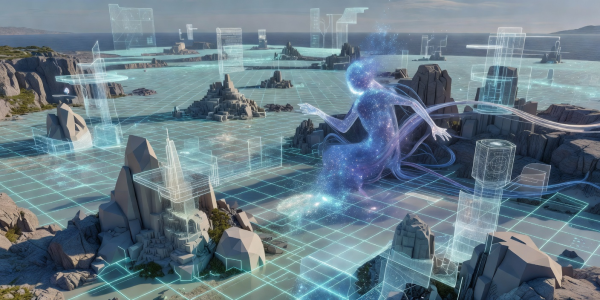
Playable Neural Worlds on Demand
Genie converts a single static user image or sketch into an interactive, playable physics sandbox.
From 2D Platformers to Embodied Robotics Training
While Genie demonstrated its capabilities on side-scrolling platformer mechanics, DeepMind’s broader objective for world models is the training of embodied agents. If a world model can accurately simulate physical interactions—such as frictional sliding, fluid spills, or robotic arm inertia—future robotics agents can be trained completely in neural imagination before touching a real piece of hardware.
This links directly to DeepMind's work with Gato, a generalist agent model demonstrating that a single set of transformer weights can tokenize Atari gameplay, control a physical robot arm, translate text, and navigate synthetic mazes.
Comparative Architecture: Physics Engines vs. Neural World Models
| Characteristic | Traditional Physics Simulators (MuJoCo, PhysX) | DeepMind Genie Neural World Model |
|---|---|---|
| World Creation | Manual 3D modeling, collision meshes & scripts | Zero-shot from a single image or text prompt |
| Supervision Method | Hand-coded differential equations | Unsupervised learning from unlabeled visual video |
| Action Grounding | Hardcoded rigid joint constraints | Discovered latent action codebook |
| Physics Consistency | Mathematically exact Newtonian equations | Neural probabilistic approximation; potential drift |
Current Frontiers and Scientific Horizons
The primary frontier for world models is memory horizon. While current iterations simulate local physics with high fidelity over short bursts, extended temporal rollouts risk architectural hallucinations where background terrain subtly mutates. Integrating persistent 3D Gaussian splatting or neural radiance fields (NeRF) into the dynamics model represents the next frontier of DeepMind's world simulation research.