Imagen 3 & Veo: High-Definition Generative Photorealism & Temporal Physics
A comprehensive technical exploration of DeepMind’s latent diffusion advancements, typography-rendering accuracy in Imagen 3, and cinematic physics rendering in Veo.
The Leap in Visual Fidelity: Imagen 3 Architecture
Early text-to-image diffusion models were notorious for common artifacts: unnatural skin textures, irregular hands, blur around fine hair details, and an inability to render legible typographical text inside scenes. Google DeepMind designed Imagen 3 to systematically address these flaws through upgraded transformer-based diffusion backbones and vastly enriched caption alignment.
Rather than using simple, keyword-based text conditioning, Imagen 3 leverages advanced multi-modal language model encoders to parse long, grammatically complex prompts. If an artist specifies exact camera lens focal length, volumetric lighting direction, depth of field, and multiple specific lines of written text on a wooden sign, Imagen 3 adheres to spatial prompt instructions with fidelity unachievable in previous generations.
Veo: High-Definition Generative Video and Temporal Geometry
Moving from static images to video generation introduces the formidable challenge of temporal geometry. Video models must not only generate individual frames with photorealistic detail, but ensure that objects maintain volume, lighting, and physical consistency across dozens of seconds of movement.
DeepMind unveiled Veo as its premier generative video foundation model. Capable of generating 1080p resolution video at high frame rates, Veo integrates visual understanding with cinematic terminology such as "pan", "tracking shot", "timelapse", and "dolly zoom".
- Spatiotemporal Latent Compression: Veo compresses raw video clips into dense 3D latent tokens, capturing both horizontal/vertical spatial layout and temporal velocity vectors simultaneously.
- Physics Simulation Consistency: Fluid dynamics (water splashes, smoke plumes) and rigid body collisions follow believable Newtonian approximations without flickering or morphing artifacts.
- Cinematic Control Conditioning: Directors can steer both camera paths and foreground subject behaviors through natural language prompt modifiers.
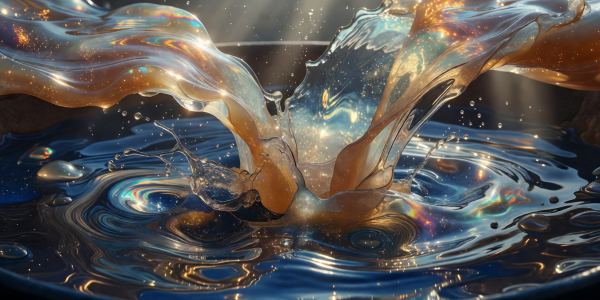
Veo Temporal Stability Benchmark
Evaluation of continuous temporal coherence across extended camera motion sequences.
Comparative Architecture: VideoPoet vs. Veo
Before and alongside Veo, DeepMind explored autoregressive video generation via VideoPoet. Understanding the architectural differences between VideoPoet (token-based autoregression) and Veo (diffusion transformer) illustrates key technical trade-offs:
| Feature | VideoPoet (Autoregressive) | Veo (Diffusion Transformer) |
|---|---|---|
| Underlying Engine | Autoregressive Multi-Task Transformer | Spatiotemporal Latent Diffusion Model |
| Temporal Extension | Recursive token continuation without degradation | Hierarchical spatiotemporal denoise iterations |
| Audio Generation | Native joint video-to-audio token prediction | Separately conditioned or post-synced audio |
| Photorealism Grade | High stylized motion; moderate texture fidelity | State-of-the-art photorealism & cinematic lenses |
Governance: SynthID Integration Across Frames
Every video generated by Veo and every still frame produced by Imagen 3 incorporates DeepMind’s SynthID digital watermarking. In video streams, SynthID embeds imperceptible mathematical signals across both spatial pixels and temporal frame sequences, ensuring synthetic media can be authenticated even after transcode recompression, frame rate downsampling, or editorial cropping.