Robotics & Embodied AI: The Vision-Language-Action Revolution
Deep analysis of Robotic Transformer 1 (RT-1), RT-2, SARA-RT, and Open X-Embodiment frameworks that bridge web-scale semantic reasoning with real-time physical control.
Bridging Cognitive Reasoning and Physical Actuation
For decades, autonomous robotics was hobbled by domain compartmentalization. Perception models detected object bounding boxes, task planners formulated symbolic sequences, and kinematic controllers calculated joint trajectories. When environmental perturbations arose—such as an unfamiliar cup color or shifted furniture—these brittle modular pipelines failed.
Google DeepMind dismantled this barrier by introducing Vision-Language-Action (VLA) architectures. Beginning with Robotic Transformer 1 (RT-1) and culminating in RT-2, robotics models treat motor commands not as distinct proprietary control signals, but as standardized linguistic tokens within an autoregressive multi-modal transformer.
RT-2: Transforming Web Pre-Training into Motor Trajectories
The core insight of RT-2 is parameter co-fine-tuning. DeepMind took multi-billion parameter Vision-Language foundation backbones (such as PaLM-E and PaLI-X) and continued training them on combined datasets consisting of web-scale text, internet images, and robotic demonstration trajectories.
To output robot motor commands, the continuous action space of a physical manipulator—end-effector coordinates (x, y, z), rotational roll/pitch/yaw angles, and gripper opening states—is discretized into integer bins. These integer bins are mapped directly to standard vocabulary tokens. When instructed to "move the apple to the napkin," RT-2 does not merely detect bounding boxes; it leverages semantic common sense learned from internet corpora (knowing that an apple is perishable, spherical, and rollable) while emitting tokenized motor vectors.
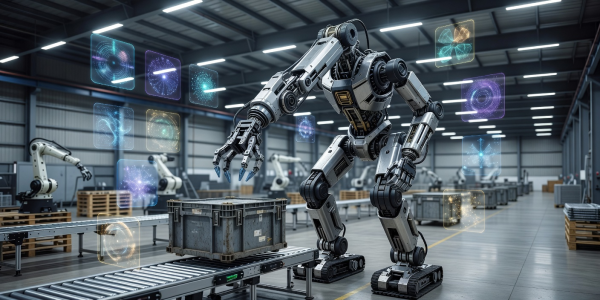
Emergent Generalization in Physical Space
RT-2 demonstrates zero-shot semantic problem solving that was never present in robotic teleoperation training sets.
SARA-RT: Resolving Quadratic Transformer Latency
While massive VLA models exhibit unprecedented semantic dexterity, physical robotic control requires stringent closed-loop frequencies. Running a 55-billion parameter transformer with standard quadratic self-attention ($O(N^2)$) yields multi-second inference cycles, rendering high-speed collision avoidance and dynamic manipulation impossible.
To solve this, DeepMind developed Self-Adaptive Robust Attention for Robotic Transformers (SARA-RT). SARA-RT employs an algorithmic kernel fine-tuning methodology that converts expensive quadratic attention layers into linear attention equivalents ($O(N)$) without demanding retraining from scratch. The result is a dramatic increase in control loop frequency—enabling complex multi-task policies to execute safely at real-time control rates on mobile manipulators.
Comparative Architecture Matrix
| Model Attribute | RT-1 (2022) | RT-2 (2023) | SARA-RT Optimization |
|---|---|---|---|
| Core Backbone | EfficientNet + TokenLearner | PaLI-X / PaLM-E VLM | Point-Wise Linear Attention Kernel |
| Semantic Generalization | Confined to trained task sets | High internet-scale zero-shot transfer | Maintains RT-2 generalization grade |
| Action Representation | Discretized bins (8-dim) | Discretized text token vocabulary | Discretized token stream with linear pass |
| Inference Rate | Approx 3 Hz on edge TPU | Slow without cloud accelerator | Up to 3× speedup over baseline RT-2 |
The Open X-Embodiment Dataset Collaboration
Beyond single-robot testbeds, DeepMind co-founded the Open X-Embodiment collaboration with 33 academic institutions. Pooling training logs across 22 different robot form-factors, 527 skills, and over 160,000 distinct operational tasks proved that multi-robot pretraining enhances performance across every individual platform—paving the way for universally deployable generalist robotic brains.